


I’ve been thinking about how easy it is to get gratitude wrong.
People have been talking about gratitude long before Oprah went on the air, and they haven’t let up since. There are gratitude books, gratitude journals, and daily reflections with a dose of gratitude stirred in. We’ve all heard the advice. What are you thankful for? Write your list and keep it on the nightstand. Take a moment every day and be thankful for something. Counselors bring it up with their clients, and articles get written about it. It shows up in memes and makes the rounds on social media all year long, and every November it comes out again in the spirit of the season.
There’s a lot out there that promises that gratitude will change your brain chemistry. Say thank you, they say, and your brain releases dopamine and serotonin, your stress hormones drop, and you sleep better. Jot down a few blessings this week, and your health will thank you.
Let me tell you, there’s nothing wrong with gratitude. I’m all for it. Anxiety and depression give you tunnel vision. You get buried inside yourself until all you can see is your own interests, your own pain, and your own feelings. One way out of that cage is service, giving your time to somebody else and spending an afternoon thinking about their troubles instead of your own. Gratitude works the same way. It lifts your eyes off yourself long enough to notice what someone else has done for you. It’s one coping skill among several.
Every good thing can be commercialized, though, and gratitude is no exception. I’m a little uneasy about the way it gets sold. When an old virtue shows up with a list of health benefits and the tone of a supplement commercial, I get suspicious. A thing can be good and still call for prudence and a healthy dose of skepticism.
We have a gift in this country for taking the old virtues and selling them back to ourselves as self-improvement. Patience used to mean bearing with difficult people and hard seasons, and now it mostly gets sold as a way to lower your blood pressure. Gratitude is headed down the same road. Most of what I read about it focuses on what the thanking will do for my mood and my sleep. The thank-you is still in there somewhere, but the person on the other end of it has slipped out of the picture.
When psychologists at Ohio State pulled together 27 studies on gratitude exercises, covering more than 3,600 people, they found the effect on depression and anxiety was small. People who kept gratitude lists or wrote thank-you letters did only a little better than people given an ordinary task that had nothing to do with gratitude. One of the researchers, Jennifer Cheavens, said it wasn’t something she would recommend as a treatment. The lead author, David Cregg, said the trouble starts “when we try to turn gratefulness into a self-help tool.”
So if you’ve kept a gratitude journal faithfully and still wake up heavy, melancholy, depressed, or overwhelmed, still stuck inside your own head, you haven’t failed at gratitude. A gratitude list can be a useful tool, and gratitude practiced well is good for anybody. It just won’t hold up as a long-term fix for your mental health, and it was never the whole answer anyway.
The first surprise is that more isn’t better. Sonja Lyubomirsky, a psychologist at the University of California, Riverside, asked people to write down five things they were grateful for over six weeks. The ones who did it once a week grew happier. The ones who did it three times a week didn’t. Her explanation made sense to me. Do something too often and it turns into a chore, and pretty soon you’re just going through the motions. Counting blessings is no exception.
Every family has watched a blessing routine go stale at Thanksgiving dinner. Somebody suggests going around the table to say what we’re thankful for. The first year it’s lovely. By the fifth year, people have their answers canned and ready. You can count on one of the older people around the table mentioning their health. Mom will wink and mention the younger ones she hopes will clear the table and load the dishwasher. You can’t manufacture thankfulness by orchestrating it.
At our house, when it’s time to go around the table and say something kind, we all hold our breath a little, because you never know what anyone is going to say or do. The younger ones usually play along. Then each of them reaches the age where being sincere in front of the family feels like torture, and they’ll do almost anything to get out of it. My wife, Jamie, and I share a grown-up, slightly sarcastic sense of humor, and neither of us is the heart-on-your-sleeve type, so it doesn’t take much to tip a sincere moment into a joke. One of the kids makes a wisecrack, everybody laughs, and then we get to the threats. Nobody moves on until you say something kind, something thoughtful, something you actually mean, and we’ll sit here until it happens.
Not long ago at dinner, I asked everyone to say something they were grateful for. Our nine-year-old said, “Oh, we’re doing this again?” Then, “Okay, I’ll go first.” And she was good. Dad works hard. Dad provides for his family. She was grateful for our house and for her room. Then she decided to go by age. Dad was done, so Mom was next, and she got stuck. Her older sister was giving her a look across the table. “Well, I’m thinking,” she said, and went back to coming up with more things about me. All the while Jamie sat there, worn out from a day of errands across town, picking up food, cooking, and cleaning, trying not to let her feelings get hurt. What was supposed to be a nice moment was starting to feel personal and a little hurtful, so we moved on to something else.
The second surprise is that it helps to imagine the good thing gone. In 2008 a team of psychologists asked people to think about how something good in their lives might never have happened. Those people ended up feeling better than the ones who simply wrote about how the good thing came to be. The researchers titled their paper “It’s a Wonderful Life.” Try it yourself. Think about the things you’re grateful for, like your job, your house, your health, the time you get with your family, or a friendship you lean on. Now imagine them gone. Poof. Maybe they never happened at all, or maybe they’re still out there, going on without you in them.
George Bailey learned gratitude the hard way, by seeing Bedford Falls without him in it. When he got his life back, he kissed the knob on the banister that had been coming off in his hand for years. Nothing in his house had changed.
I don’t have to work very hard to imagine my own life with some of its best parts missing. I met Jamie around midnight in an empty Waffle House. I happened to be there with a mutual friend who knew her. We didn’t run in any of the same circles, and I can’t think of a single other way our paths would have crossed. It had to happen how it happened, when it happened, and where it happened.
I wasn’t supposed to be at that college in the first place. It was early August. I was living in Virginia, and the school was in Arkansas. Classes started at the end of the month, admissions had closed, and everybody who planned to go to college that fall had their plans set. I had no intention of going anywhere. Then one day I had a thought that was about as close to a plan as I had in those days. I’m not sure what I’m doing. I guess I should go to school. My mom helped me get everything done, and a week and a half later I was sitting in a dorm room halfway across the country.
Everything since then sits on top of those two moments. Jamie and I have lived in Arkansas, Virginia, Savannah, and Houston, and moved more than once within each of them. We made friends in every one of those places. Our five children were born in five different hospitals in five different towns. The good things and the bad things, the hard years and the thankful ones, all of it traces back. Take away one piece and the whole line of dominoes comes down.
I have my share of regrets. I’ve made mistakes and poor judgments, and I haven’t made all the choices I wish I had. But good things came out of some of those failures, too. I don’t recommend planning failures into your future but I do recognize that God used some of those moments to bring me something, or someone, that means the world to me. When I look back over all of it, I know who to thank.
You Can’t Thank the Universe
It still amazes me how far gratitude has traveled in a secular culture. It has found a place in medicine and mental health care, and people practice it no matter what they believe. Even folks who don’t believe in God will say they’re thanking the universe, as if you could toss your gratitude up into the sky and let it land wherever it lands. I understand the impulse. The heart wants somewhere to send its thanks. But it leaves me asking, thankful to whom, and for what? Gratitude runs both ways. A gift comes from someone, thanks go back to that someone, and they receive it. When I thank someone, I’m admitting I needed something I couldn’t give myself. The person I thank finds out they were seen, and they get a chance to answer. The thanks goes back and forth between the two of them the way love does, and they grow a little closer each time. When the only one on the receiving end is the sun or the cosmos, something crucial has gone missing. You can’t thank the universe. It can’t hear you, and it can’t answer. To see what gratitude looks like when it has someone to go to, I go back to Luke.
Where Are the Other Nine?
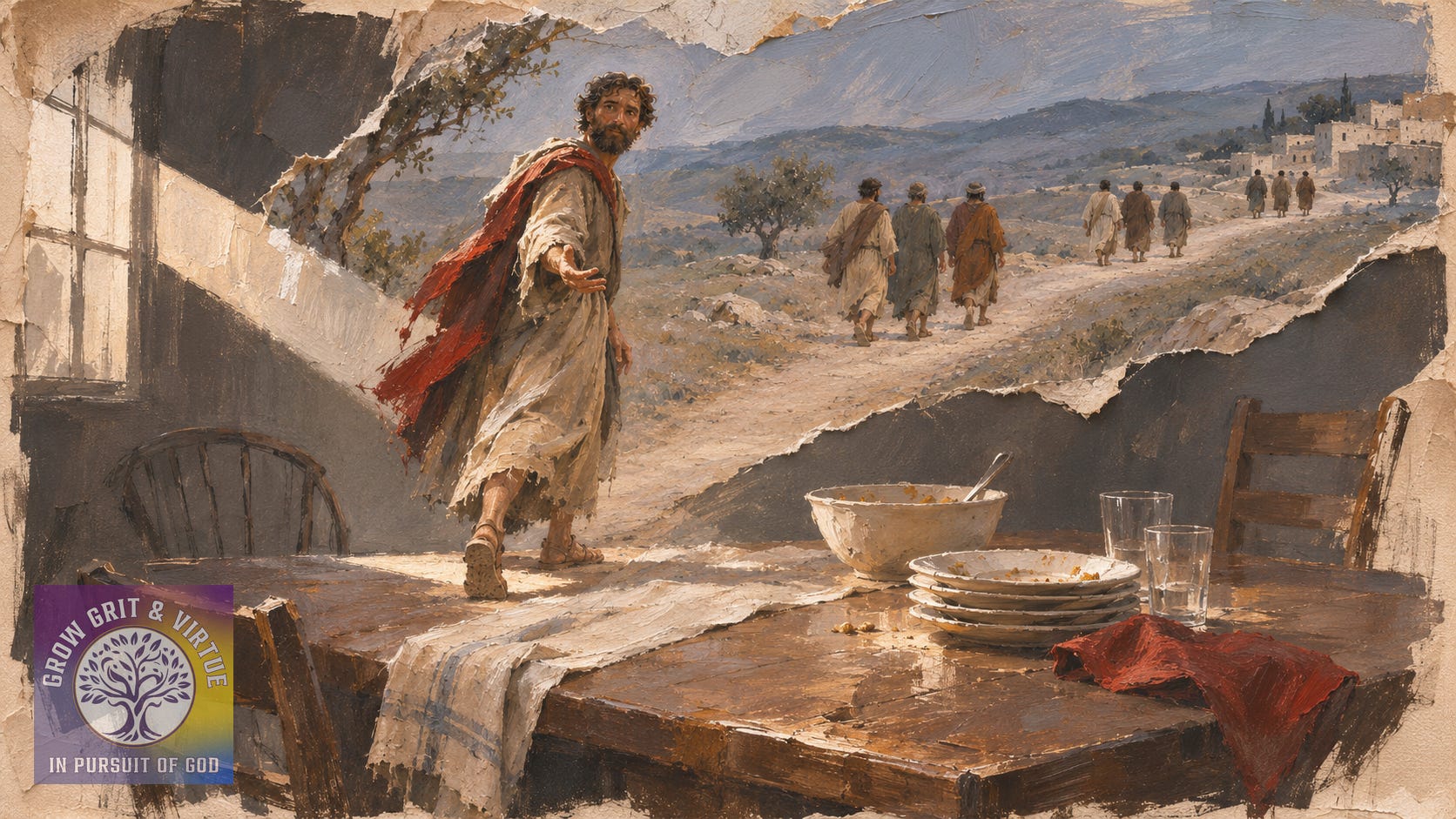
In Luke 17, Jesus is on the road to Jerusalem when ten lepers call out to him from a distance. Under the law of Moses, a man with leprosy lived outside the village, away from his wife and children, and had to call out “Unclean!” if anyone came near. He could go home only after a priest examined him and declared him clean. So when the ten beg Jesus for mercy, he simply tells them to go show themselves to the priests. They turn and go, still sick, and somewhere along the road all ten are healed.
Nine keep walking. I wonder if I’d have been one of them, halfway to the priest and already rehearsing what I’d say when I walked through my own front door. In fairness to the nine, they were doing exactly what Jesus told them to do. They had a priest to see and families they hadn’t spent time with in years waiting. Most ingratitude looks a lot like that. It’s usually unintentional. We’re busy, and we have somewhere to be.
One man turns around. Luke says he came back praising God at the top of his voice, fell at Jesus’s feet, and thanked him. Then Luke adds one more detail. “He was a Samaritan.” Jews and Samaritans had despised each other for centuries. Jesus calls him “this foreigner.”
Jesus asks, “Ten were cleansed, were they not? Where are the other nine?” Then he tells the Samaritan to stand up and go on his way. “Your faith has saved you,” he says.
All ten received healing, but only one came back to the person who gave it, and only that one heard those words. Going back cost him something. He had to stop and walk back the way he came while the other nine kept going. Real gratitude points at someone. It goes back to the one who gave the gift.
It’s the pointing at someone that also makes gratitude hard. To thank someone, I have to admit I didn’t do it all myself. I needed help. Asking for help, or even accepting it when it’s offered, is a wound to my pride. I don’t want to be a bother. When you’re leading a family or an organization, you don’t want to look weak, or uninformed, or unable to handle what’s in front of you. Sometimes I’m so set on not needing help that I miss it when someone else needs mine.
But who actually has it all together? Who has all the answers and all the abilities? Pride would rather feel self-made, or quietly entitled, as if the good things in my life simply showed up because I had them coming.
Our counselors at Shield Bearer Counseling Centers see resentment grow in the places where gratitude should be. A big reason is that most of what we give each other goes unseen. You know exactly what you’re carrying, the worries you take to work and back, the problems you turn over in the wee hours of the morning, the good you meant to do. What you can’t see is what the other person is carrying. You can see every single thing they haven’t done, though, and they’re looking at you the same way. When both people feel unnoticed, both of them start keeping score.
I know how that scorekeeping works because I do it. For me it usually starts with a sink full of dishes. I see them when I go to bed. I see them in the morning while I’m getting ready for work. I see them again when I get home. By then my mind has made a list of everything that isn’t getting done, and my heart is full of ingratitude. I might never say a word to Jamie about those dishes, but she hears it anyway. What I don’t see is her day. I don’t see the hundred small negotiations with the children, the worries she has held inside, the struggles that never make it to my ears. All I can see is my own column. I’m working and paying the bills and doing my part. And while I’m busy keeping the books, she’s going to bed wondering if anybody noticed anything she did all day.
I’ve misused gratitude, too. Gratitude is a poor way to shut someone up. As a parent, I’ve often been the one who keeps “You should be grateful, others have it worse” at the ready for emergencies when one of my kids complains and it feels personal. I hear: I’m not the father I should be. I’m not providing the way other parents provide. So I reach for the line, mostly to make the complaining stop. There’s some truth in it, but it comes out of my wounded pride.
Think about how it sounds on the other end. My child came to me with something that hurt. What they hear back is that they’re ungrateful for feeling that way and should be ashamed for bringing them up. Now they’re carrying the original hurt plus the guilt of having felt it. I’ve passed my shame on to them. The conversation ends, which is what I wanted, and the next time something hurts, they may decide not to bring it to me at all.
None of that means gratitude has no place when life hurts. Paul wrote, “In all circumstances give thanks.” He was writing to the Christians in Thessalonica, who had received the faith “in great affliction” and were still under significant social and political pressure from their neighbors. Look at his little word “in.” Paul asks them to give thanks while the trouble is still going on.
We lived through something like that once. The house we were renting was condemned because of black mold, and it had made us sick. We had no one helping us legally and not much money. I was working for a nonprofit, and Jamie was home with the kids, including a baby. We negotiated a couple of weeks in a hotel, and after that we had no idea where we would end up. Our younger ones, somewhere around eight to ten, thought it was an adventure. They loved the fast food and sharing beds. There was no bedroom to disappear into and no backyard to play in. Everybody was together all the time. If somebody needed to go down to the lobby, everybody went, and nobody was left in the room. Jamie and I were full of fear, dread, and stress, and our kids were right beside us every minute, seeing it all so differently than we did. That’s where the gratitude came from.
The Psalms do the same thing. They complain, weep, and give thanks, sometimes in the same breath. Psalm 13 asks God “How long?” four times in its opening lines, and a few lines later it promises to sing.
Holidays at our house have a little of both, gratitude and sorrow. Jamie and I are each the youngest in our families, and we’ve lost most of our parents. My dad is the only one left, and he lives far enough away that we don’t see him often. We both grew up with Thanksgiving tables crowded with parents, grandparents, aunts, uncles, and cousins. Everybody brought something. Somebody was known for the snickerdoodles, somebody else for the deviled eggs, the corn casserole, the dressing, or the secret ingredient in the cranberry sauce. These days it’s mostly just us and our kids. I’m grateful for every one of them, and I still feel the loss. Our kids aren’t growing up with what we had at their age.
So here’s a practice for this Thanksgiving and the days after that…
Once this week, and only once, choose one good thing and picture your life without it. Take your time. Then thank God for it specifically.
Go back to one person, the way the Samaritan did. Tell them exactly what they did for you and what it meant. Skip “thanks for everything.” Name the thing.
If you’re carrying depression or anxiety, let gratitude keep you company, and get real help too. That’s what Shield Bearer is here for.
Thursday our table will be smaller than the ones Jamie and I grew up around. The dishes will stack up in the sink, the leftovers will go into plastic containers whose lids disappeared, and somebody will fall asleep in the recliner (me likely). At some point one of the kids will make a wisecrack when it’s their turn to say something kind, and we’ll sit there until they do.
The research says gratitude exercises do only a little for anxiety or a low mood. I think that’s because we keep using gratitude on ourselves, when it was meant for someone else. It does its real work when it goes back to the person who gave you something. When I tell Jamie something specific I noticed her doing, she knows somebody sees her, and I stop keeping score. With my kids, being grateful instead of defensive means I listen instead of reaching for “others have it worse.” Every honest thank-you to God reminds me that none of this was mine to begin with. All ten lepers got their healing. The Samaritan also got to thank the one who healed him face to face, and he heard Jesus say, “Your faith has saved you.”
Jamie and I would love to rebuild some of what we grew up with and pass it on to our kids, and someday to theirs. The recipes will help, and so will people at our table telling each other, out loud and in specifics, what they’re grateful for in each other, and meaning it, year after year, until it’s simply how our family does Thanksgiving. So on Thursday, after the plates are cleared, do what the Samaritan did. Find someone who gave you something good this year and go tell them what it meant.
Thank you for reading. If this essay brought someone to mind who you need to thank, I’d be grateful if you shared it with them.
I want to write things that actually help you, so tell me in the comments what you’d like me to take on next.
If you’re not subscribed yet, you can join here for free or…:
Paid subscriptions support my writing and the work of Shield Bearer Counseling Centers. We provide licensed counseling to individuals, couples, children, and families, and no one is turned away because they can’t pay. If you’d rather give to Shield Bearer directly, you can do that here:
If you or someone you love is having a hard time this season, you are in my prayers.
From our family to yours, Happy Thanksgiving, and may God bless you this Advent and Christmas.
Thad