


For most of the year, the church calendar is in no particular hurry.
Churches that follow the old Christian calendar call the long stretch between Pentecost and Advent “Ordinary Time.” The name doesn’t mean plain or dull. It comes from the way the Sundays are counted, the Second, the Third, the Fourth, numbered one by one. Its color is green, the color of growth. Week after week the Gospel readings follow Jesus through Galilee, healing and teaching, and nothing about it asks you to rush. For months the Sundays keep the same patient beat, one green week after another.
Then the school buses come back, and somebody picks up the tempo.
It starts innocently enough. There’s a back-to-school night, a fall fundraiser, and a catalog of overpriced wrapping paper that we have somehow agreed to sell. Then come the fall festivals, and one year that meant a late night spread across the family room floor turning household goods into the archangel Michael: a pot lid for a shield, a rubber spatula wrapped in foil for a sword, cardboard paper towel rolls duct-taped to shins and forearms for armor, and a colander for a helmet. Our little archangel looked less like the prince of the heavenly host than a kitchen drawer that had gone to war, and nobody was ever prouder. Before the candy is gone, someone asks where we’re doing Thanksgiving this year. Then come the banquets and the band concerts, the semester exams, the college kids home with a carload of laundry, and the aunt whose flight lands at 11:40 at night. Work wants everything wrapped up before the year ends. The church bulletin fills with carol sings and Christmas programs. And the family budget, which was already doing the best it could, is asked to do quite a bit more.
By the end of November the drum is pounding like a high school marching band. And it is exactly then, often on the Sunday right after Thanksgiving, with the turkey still in plastic containers in the refrigerator, that Advent begins and asks us to wait.
This year will be different
I don’t know a single Christian parent who walks into Advent without a plan.
Ours usually gets made on the drive home from Thanksgiving, a day or two before the first Sunday of Advent. This year, we tell each other, will be different. We will light the wreath every night. We will pray together after dinner, everybody, even the teenager. We’ll put shoes out for St. Nicholas on the sixth. We will do the Jesse Tree, every ornament, in order.
I know how this goes because one year I bought the dream outright. We were at an Advent fair at our church, and there was a silent auction to raise money for the school. On one table sat a Jesse Tree, about two feet tall, its green needles frosted at the tips, every branch hung with a beautiful handmade ornament. I stood there and watched our whole future unfold: the children coming downstairs in slippers and Christmas pajamas, all of us with a hand on an ornament, someone reading the Bible verse, the stories, the glow. We wrote down our modest bid. That afternoon, we won. A new family tradition was about to be born.
That tree did not make it to its first Advent in our house, at least not in one piece. By December it was bent and sparse. Ornaments went missing. We were still finding them on windowsills the following July. You can win a Jesse Tree at a silent auction. The peaceful family in matching pajamas, it turns out, is not included.
Every one of those hopes is good. There’s nothing foolish about wanting your family to be holy and to grow closer to the Lord.
Then real life pulls into the driveway with its luggage. Jamie and I have children of many different ages, which means that over the years, on any December evening someone is teething, someone has a science project due, someone needs a ride, and someone is asking why we can’t just put the tree up like normal people. By the second week of Advent the wreath has been lit possibly twice, and the Jesse Tree, if we still have one, is stuck somewhere around Noah, which, given the way the season floods in, seems about right.
It doesn’t help that Jamie and I didn’t grow up with any of this. We came to these old traditions as adults. So we met other Christian families who seemed to have it all together, and we quietly concluded that they were simply better at faith than we were. Better parents, too. More discipline, more virtue, more patience, more everything. They said things like “In our family, we always…” and “Our children have a tradition where…” and “This is how we’ve celebrated for years.” Every sentence sounded like a Norman Rockwell painting, and every one left me feeling like we were neglecting our children. So we went home and tried to bolt their traditions onto our life, which is a little like improving your swimming by diving into the shallow end. Some seasons, getting everyone fed and to church was the whole victory.
I’ve since come to see those families differently. Most of them were working just as hard as we were, and their traditions had grown over many years, one small habit at a time. They weren’t showing off. They were sharing what they loved, and they were a gift to us. The problem was me, comparing our worst weeknight to their best story.
Still, in the thick of December, the guilt arrives. We dreamed of a holy Advent and handed our families a frantic one. We feel as if we’ve been run over by a truck.
Most of us don’t fail at Advent because we care too little. We fail because we try to win it. We take the one season built for waiting and turn it into another thing to get done. The answer isn’t a better plan. It’s something much smaller, and I first learned it from two religious sisters around their coffee table in Savannah, Georgia.
A candle on a coffee table
Before we had children, Jamie and I took classes together to join the Catholic Church at Sacred Heart in Savannah. Our guides were two sisters who met with us in the small living room of the church’s old rectory.
Getting there was always a scramble. I was teaching school then, which meant I never went anywhere without a stack of ungraded and poorly written papers. We were down to one car, and Jamie and I worked on opposite sides of town. On meeting nights I’d leave school, drive across Savannah in traffic to pick her up, then drive back across Savannah in more traffic, checking the clock at every red light. Most weeks we came through the rectory door a little late, a little damp, and thoroughly frazzled. We were trying to grow in our faith, and mostly we were succeeding at becoming late.
And every week, the sisters were ready with the same small ritual. One of them laid a doily on the coffee table. On it went a single candle and a few cards with prayers printed on them. The lamps were already turned low. Once we had sat down and caught our breath, they lit the candle, and we prayed the Lord’s Prayer together. Then we simply asked God for His grace and mercy, and for the Holy Spirit to be with us.
That was all. There was no lecture on stress. Nobody told us to slow down. They didn’t need to. Somewhere between “Our Father” and “deliver us from evil,” the traffic drained out of me and the papers in the car stopped mattering. I remember feeling, almost physically, that for the first time all day somebody other than me was setting the pace. In that room, the pace belonged to the Lord. We had only to show up and be handed back to Him.
I’ve thought about those evenings many times since. Those two women understood something about the human heart that I am still learning. You cannot argue a frantic person into peace. But you can light a candle, begin to pray, and let God do what only God can do.
The good news is that you don’t need a rectory or a pair of sisters to have this. Christians have been handing the same small mercy to ordinary families for generations. It is probably in a box in your garage, next to the Christmas lights. It’s the Advent wreath. No family is required to have one. It’s a custom, not a rule, and for a busy household it may be the gentlest place to start.
The church in your house
Before we get to the candles, it’s worth remembering why the prayers of one ordinary family matter so much.
When Paul sent greetings to Priscilla and Aquila, he also greeted “the church that meets in their house” (Romans 16:5). Long before there were cathedrals, Christians gathered around kitchen tables. Moses told the people of Israel to talk about God’s words “when you sit at home and when you walk along the road, when you lie down and when you get up” (Deuteronomy 6:7). The home has always been where faith gets taught first.
So a prayer said over macaroni and cheese, with a toddler kicking the table leg, matters. Jesus promised that “where two or three gather in my name, there am I with them” (Matthew 18:20), and He didn’t say anything about the table being clean. A family at prayer doesn’t have to look like a cathedral, and on most weeknights ours looks more like a bus station. It gathers around ordinary things: a table, a few minutes, a handful of people who love one another most of the time, and the willingness to turn together toward God. For one hour a week, the sisters gathered us around a coffee table to pray. Your family can gather around the kitchen table and do the same thing every evening.
Why the wreath refuses to hurry
The Advent wreath is younger than most people think. The modern version is usually traced to a Lutheran pastor in Hamburg, Johann Hinrich Wichern, who in the 1830s set candles on an old cartwheel so the children in his care could count the days until Christmas. Over time the wheel shrank to an evergreen circle with four candles, and Christians of nearly every tradition took it into their homes and churches.
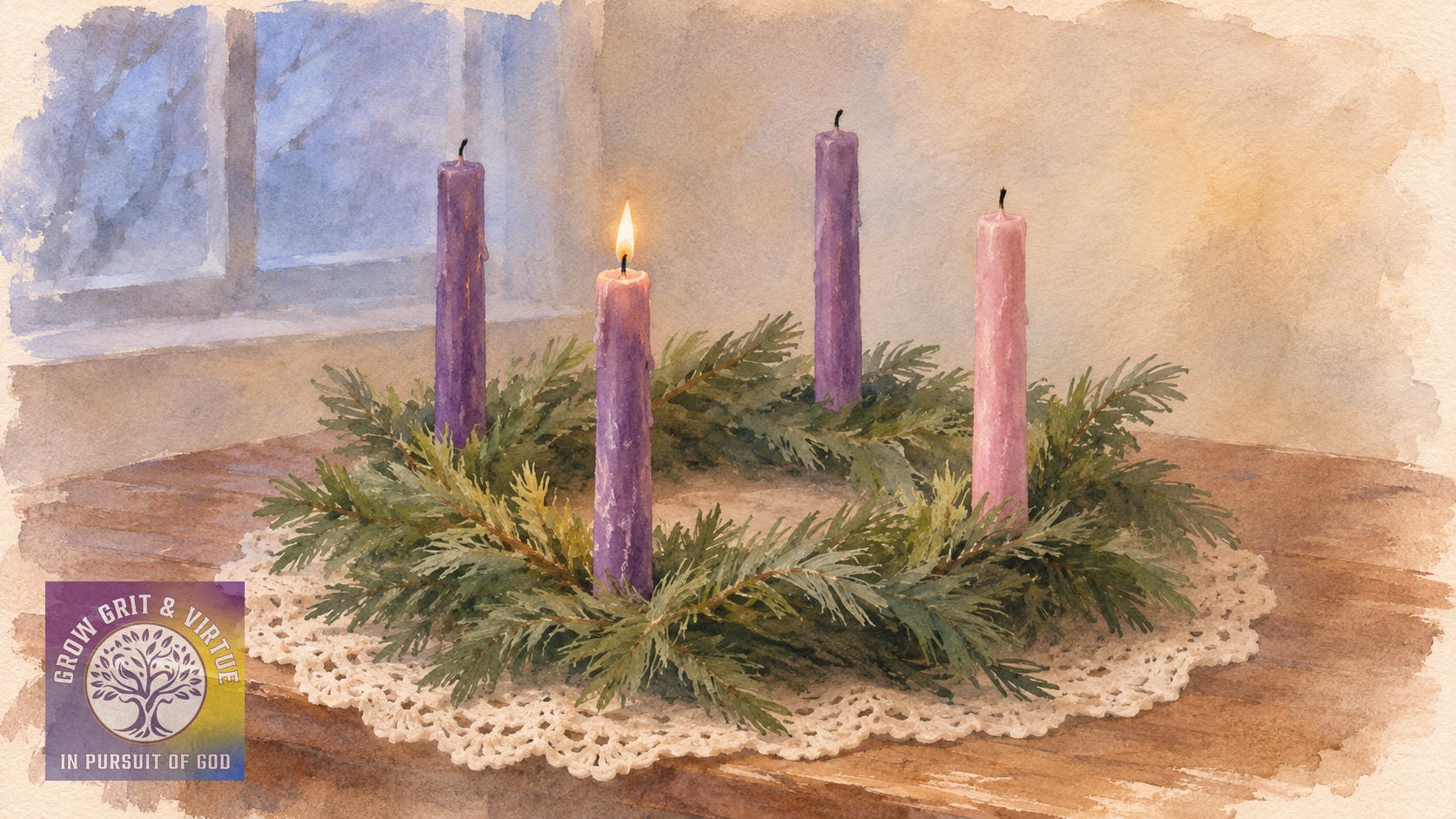
The idea behind it is simple. Each Sunday you light one more candle, and the light grows a little at a time, the way the promises of God grew brighter through the long centuries before Christ came.
Everything else in December arrives all at once. The wreath does not. It gives you one candle the first week, and one candle doesn’t light much of anything. The second week, two. By the fourth, the whole circle glows. You can’t rush it. Lighting all four on the first Sunday to get ahead would miss the point entirely. The wreath keeps God’s pace, which is the pace of a long and patient promise.
Each part of it teaches something:
The evergreen circle. Branches that stay green through winter speak of life that doesn’t fade. The circle, with no beginning and no end, points to the eternal God who chose to enter time.
The four candles. One for each Sunday. As the light grows, it recalls how God’s promises grew brighter through Abraham, the prophets, John the Baptist, and finally Mary’s “May it be to me as you have said” (Luke 1:38).
The purple. Most wreaths use purple candles, the color of waiting and preparation, the same color many churches use in Advent.
The pink candle. Many wreaths have one pink candle for the third Sunday, often called the candle of joy. Its old name, Gaudete Sunday, comes from the Latin word for “rejoice” in Philippians 4:4: “Rejoice in the Lord always.” It is a small burst of joy at the halfway mark, and it tends to arrive right when a family is running on fumes.
In a month when everything else is speeding up, the wreath sits in the middle of the table and politely declines to join in.
Five minutes at the table
So how do you actually do this, with real children and a real calendar? Aim lower than you think you should. Picture the sisters’ coffee table: a candle, a prayer, a moment of quiet. Here is a simple pattern that works for many families.
Begin with a short prayer on the first Sunday of Advent. Thank God for sending His Son and ask Him to bless your family’s waiting. Many churches print a family wreath prayer in their Advent guides, but your own words are fine.
Stop. Turn off the screens. Dim the lights if you can. Let everyone sit still for a moment, which for some children will be the most demanding spiritual discipline of the year.
Light the candles for the week. Let the children take turns. In our house, the right to strike the match is negotiated with the seriousness of an arms treaty.
Pray the Lord’s Prayer together, the way we did in that rectory living room. Then ask the Holy Spirit to be with your family.
Read one short passage of Scripture. Isaiah, the Gospel of Luke, or your church’s Advent reading can carry you all week. For small children, one verse is plenty.
Sing one verse of “O Come, O Come, Emmanuel,” if your family sings, and add a verse each week as the light grows. If your family doesn’t sing, God has heard worse.
That’s five minutes. On a bad night it’s one: light the candle, say the Lord’s Prayer, blow it out. That counts. If the baby wails through the whole thing and your fifteen-year-old prays with all the enthusiasm of a hostage, it still counts. What matters is that, for one minute, the household stops setting its own pace and turns toward the Lord.
Adapt it without apology. With toddlers, keep it to the lighting, one sentence of prayer, and the blowing out, which they will regard as the main event. With teenagers, hand over a real job, like choosing the reading or offering the prayer request. People rarely roll their eyes at something they’re in charge of. Couples without children at home might read a psalm together by candlelight. If you live alone, keep the wreath just the same, perhaps with your morning coffee. A praying household isn’t measured by headcount.
Fewer traditions, more peace
Advent comes with a long list of good customs, and here is where many of us get into trouble. We treat that list like a buffet we are obligated to finish.
Our family loves St. Nicholas Day. Some years it’s lovely. Some years the shoes go out on the fifth and the chocolate coins don’t turn up until the seventh, and St. Nicholas has some explaining to do. What I’ve learned is that these customs are gifts, not tests. Nobody has to open all of them in one year.
Pick one or two that fit this particular December, and let the rest wait for another one.
The Jesse Tree. Named for Isaiah’s prophecy of “a shoot from the stump of Jesse” (Isaiah 11:1), it is a small tree or branch hung each day with an ornament telling the story of the Bible, from creation to Bethlehem. If you fall behind, the patriarchs are patient. They’ve waited longer than you.
The empty manger. Set out an empty manger early in Advent with a little pile of straw beside it. Each act of kindness or patience earns one piece of straw, so that by Christmas Eve the baby Jesus has something soft to lie on. Children get to help build the Christmas story out of their own small kindnesses.
St. Nicholas and St. Lucy. Christians of many traditions remember these two in December. Nicholas, the fourth-century bishop behind the Santa Claus legend, is remembered on December 6 for his quiet generosity to the poor. Lucy, whose name means “light,” has her day on December 13, and in Sweden it is a festival of candles in the darkest part of winter.
The O Antiphons. For the last seven days before Christmas Eve, Christians have long greeted Christ by ancient names from the prophets: O Wisdom, O Lord, O Root of Jesse, O Key of David, O Dayspring, O King of the Nations, O Emmanuel. They are the source of “O Come, O Come, Emmanuel.” Reading the day’s title at the wreath brings your family into that last week of longing.
And if you miss a tradition, or a whole week, the wreath will still be there on Sunday with one more candle to light.
When the neighbors already have their lights up
Most of us live surrounded by an early Christmas. The office party is in the first week of December. The school concert is full of carols. The house down the street has had an inflatable snowman on the lawn since the day after Halloween, and he looks very happy about it.
Christian families handle this in different ways. Some keep the tree bare until Christmas Eve. Others decorate early and save certain things for later. Faithful people land in different places here, and that’s all right. Advent is a season of hope, not a contest, and no one was ever drawn closer to Christ by being glared at over a snowman.
A few gentle habits can keep the season its own without making anyone miserable. Let the Nativity figures arrive at the manger one at a time, and lay the baby Jesus there on Christmas night. Save a few favorite carols for Christmas Day. Keep the wreath at the center of the table while the rest of the decorations wait their turn.
Then, when Christmas finally comes, celebrate it for all twelve days and beyond. The traditional Christmas season runs from December 25 to Epiphany on January 6. One of the quiet rewards of keeping Advent is that you still have Christmas left when everyone else is dragging their tree to the curb.
Giving the pace back to the Lord
I still think about that little room in Savannah: the lamps turned low, the doily, two young believers coming in from the traffic with papers in the car and the whole day still buzzing in their ears. And two sisters who never once told us to calm down, but simply struck a match and began, “Our Father.”
Your Advent this year will not be perfect. Mine won’t be either. The calendar will still be full, and the drum will keep beating faster all the way to Christmas Eve. But every evening you can gather whoever happens to be home, light a candle, and pray the prayer Jesus taught us. For one minute, you can hand the pace back to the Lord.
That is what the wreath teaches, one candle at a time. Peace doesn’t come from finally getting everything done. Hope doesn’t arrive all at once on one frantic night. It grows slowly, Sunday by Sunday, in the patient light of God’s promises.
Light the first candle. He will take it from there.
Thank you for reading. If this essay was a help to you, please consider subscribing to Grow Grit & Virtue. Paid subscriptions support my work at Shield Bearer Counseling Centers in Houston, where we offer licensed, trauma-informed counseling to individuals, marriages, and families, including survivors of human trafficking, and never turn anyone away because they can’t pay. And please pass this along to a friend who could use a little more peace this Advent.
May the peace of the Lord be with you and your household this Advent.
Oh, man. This is so encouraging. And beautiful.
Thank you so much for this. I think a whole lot of people need to hear this in this “most wonderful time of the year”. ❤️🙏🏻