


Jesus had just been baptized in the Jordan. As he came up out of the water, the Father’s voice said, “You are my beloved Son” (Mark 1:11). Then the Spirit led him into the desert, where he fasted for forty days. Matthew tells us, with some understatement, that afterward “he was hungry” (Matthew 4:2). That’s when the devil showed up.
His first words were “If you are the Son of God, command these stones to become loaves of bread” (Matthew 4:3).
He used one small word, if. The Father had just said, plainly and with no conditions attached, “You are my beloved Son.” The devil left those words in place and tacked a condition onto them. Jesus could be the Son of God, as long as he proved it. He’s been using the same trick on the rest of us ever since.
Every temptation hangs on a condition
The devil didn’t stop at bread. Next he took Jesus to the top of the Temple and said, “If you are the Son of God, throw yourself down” (Matthew 4:6). He even quoted Scripture, a psalm promising that angels would catch him (Psalm 91:11–12). For the third temptation, he took Jesus up a very high mountain and showed him all the kingdoms of the world. This time he stopped asking Jesus to prove anything and simply made an offer. “All these I will give you, if you will fall down and worship me” (Matthew 4:9).
The first two temptations were clever, because they could easily have passed for devotion. Jesus could have told himself he was simply proving his Father right, or showing the world God’s power. They also went after ordinary needs, food and safety, the very things any of us would ask God for. Jesus turned down all three. Making bread out of stones or jumping off the Temple would have meant treating his Father’s word as an open question, and for Jesus it was settled. Each time, he answered with Scripture. To the first temptation he said, “Man shall not live by bread alone, but by every word that proceeds from the mouth of God” (Matthew 4:4). One of those words was “You are my beloved Son,” and Jesus let it stand.
Temptation still works that way, especially on people who are trying to do the right thing. It usually starts with if, and it usually appeals to something good. If you really want to protect your kids, you’ll read every text and check out every friend. A mother who believes that turns her care into control, and her daughter learns to hide things. A husband hears If you want to protect your marriage, don’t bring that up, so he keeps quiet about what’s really bothering him, month after month, until the distance between him and his wife is bigger than the problem ever was. And a father hears If you want to provide for your family, take the extra shifts. He secures his children’s future and misses their childhood. Each of those voices sounds responsible. Underneath, they all say the same thing. It’s all up to you, so take control, because God might not come through.
Our own ifs
Other ifs are quieter, and they usually sound like our own thoughts. Listen to the ones that run through your head on a hard day. If she really respected me, she wouldn’t talk to me like that. If God really cared about me, he wouldn’t let this happen. What if I lose this job and everything falls apart? If only I hadn’t said that.
The first two do what the devil did in the desert. They demand proof. She has to prove she respects me, and God has to prove he cares. The other two pull you out of the present. A “what if” drags you into the future, where you rehearse disasters that haven’t happened. An “if only” drags you into the past, where you keep replaying something you can’t take back. Either way, you’ve left today, and today is the only place where you can pray, apologize, or do anything at all. It’s also where God meets you. Jesus taught us to pray for our daily bread, and that’s still how God provides, one day at a time.
Some ifs are harder to catch, because they never use the word. Here’s a test worth trying the next time a thought leaves you discouraged. Look for the if hiding inside it. Say your son is struggling, maybe with money, maybe with his faith, and the thought you can’t shake is I’ve failed as a father. It sounds like a simple fact. Dig a little and you’ll find the condition underneath. If I were a good father, my son wouldn’t be struggling or walking away from his faith. Now look at what that condition assumes. It says your worth depends on your son’s choices. God never said that. He is the only perfect Father there has ever been, and his first children disobeyed him in the third chapter of Genesis.
Once you see the if, you can answer it with the truth. My son is struggling. I love him, and I’ll keep showing up for him. And I’m still God’s son, whatever happens next.
I know those voices well. Our family has had more than its share of hard years. At different times I’ve needed a bigger salary, a new position, or a place for us to live. We’ve moved across the country and lost our things to flooding. Through all of it, the ifs kept coming. If I were a better provider. If only I had made a better decision. If I had prepared better, or were more qualified, or stronger, or smarter. When I was teaching, I was convinced I was a terrible teacher. In ministry, I doubted I was the right man to lead the work. Counselors call that impostor syndrome, the feeling that you’re a fraud and someone is about to find out. On the worst days, I wondered whether my wife and kids would be better off with a different man in my place.
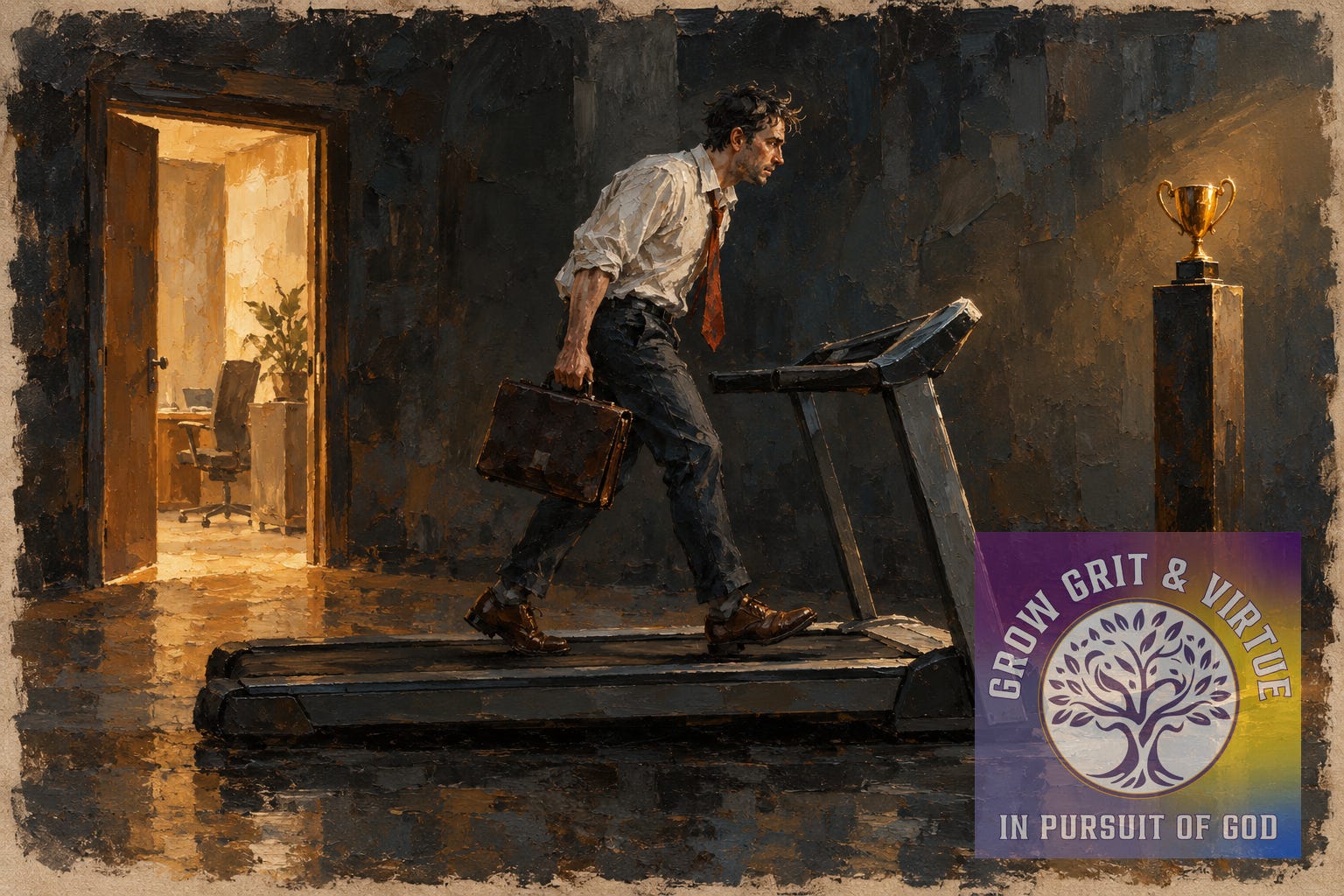
Those ifs did more than keep me up at night. For a while they ran my life. When the economy collapsed in 2008, I was laid off, and jobs were scarce. I ended up working three jobs and going to school for two master’s degrees at the same time. I was rarely home, and I slept in my car between shifts. One day, after a quick nap in the back seat and a rushed change of clothes on the way to my next job, I ran a red light and was in a bad wreck. If you want to provide for your family, take the extra shifts. I had believed that voice completely.
Humility that argues with God
Around that time a friend offered to help me, and I told him everything was fine. He didn’t buy it. “Get off your high horse,” he said. “You’re being prideful. You need to let me do the good of helping you. That’s my gift, and you’re stealing it from me.” He was right. My long hours and my “I’m fine” were fear dressed up as humility, and under the fear was pride. I had decided that everything depended on me. And I do the same thing with God. He offers me his love as a gift, and I try to hand it back.
When I picture God the Father calling me his beloved son, my first reaction is to set him straight. Thank you, Lord, but you don’t know the half of it. You’ve forgotten the selfish things I’ve done. Other times I make him a promise instead. Give me a little time to clean up my act, and then I’ll deserve it.
Both of those feel like the humble thing to say. I’m a sinner, and a sinner ought to admit it. But listen to what I’m actually telling him. When I set him straight, I’m saying he has the wrong man, as if I know myself better than the one who made me. When I promise to clean up my act first, I’m sneaking in an if. I can be God’s son, as long as I earn it. That’s the same kind of condition the devil tried to attach in the desert.
To be humble is to walk in truth. Real humility agrees with God about who you are. It sees your sins honestly and your gifts honestly, without making either one bigger or smaller than it is. False humility uses the same words, but it argues with God. It puts your opinion of yourself above God’s opinion of you.
“Lord, I am not worthy that you should enter under my roof, but only say the word and my soul shall be healed.” Catholics pray that line at every Mass, right before Communion. The words come from a Roman centurion who asked Jesus to heal his servant (Matthew 8:8). He knew he didn’t deserve to have Jesus under his roof, and he said so. He also believed Jesus could heal his servant from where he stood, with a single word. Jesus was amazed by his faith (Matthew 8:10).
The centurion started with the same words false humility uses. I am not worthy. Then he finished the sentence with trust. Only say the word. False humility finishes it with doubt. I am not worthy, so you can’t really mean it. It hears God say, “You are my beloved son,” and argues with him.
False humility has another use that’s worth admitting. It gets me off the hook. If I’m hopeless, then nobody can expect much of me, including God. “I’m just not the kind of person God uses” sounds modest, and it’s often a polite way of turning down whatever he’s asking me to do. If I’m quick to say how terrible I am and slow to change anything, I should ask myself whether all that talk is just a way to get out of doing it.
When the ifs get loud
The ifs get loudest in hard seasons. There are two kinds of seasons a person goes through. The good ones are called consolation. Those are times when your faith, hope, and love are growing, and it gets easier to love God and the people around you. The hard ones are called desolation. You feel heavy, restless, and discouraged. God seems far away, and you’re drawn toward whatever will numb you.
When you’re in desolation, never make a major decision. Stick with the choices you made back when you could see clearly. In consolation, it’s usually God who is guiding your thoughts. In desolation, the devil does most of the talking. He’s the same one who said “if” to Jesus in the desert, and nothing he tells you will lead to a good decision. Desolation also makes your problems look bigger than they are and your options look fewer than they are. That’s when the angry email you typed at eleven at night seems perfectly reasonable, and so does quitting your job. Most of us have read an email like that the next morning and thanked God we never hit send. Wait until the heaviness lifts before you decide anything big.
Knowing all this doesn’t make the heaviness go away. You can understand exactly what’s happening and still feel stuck. What helps is to keep up with your ordinary duties, like packing the lunches and showing up for work. Tell someone you trust what’s going on. The devil wants his suggestions kept secret, and once you say them out loud to a wise friend or a priest, they lose much of their power. Then let that person help you. That’s the gift my friend was trying to give me.
Answer the ifs with something true, the way Jesus did in the desert. He had Scripture ready, and he used it. It’s worth memorizing a few verses of your own before the hard days come. Romans 8:1 is a good one to start with. “There is therefore now no condemnation for those who are in Christ Jesus.”
Most of all, when the ifs get loud, go back to what the Father said at the Jordan. “You are my beloved Son; with you I am well pleased” (Mark 1:11). There was no if in that sentence, and there isn’t one in what he says to you.
Thank you for reading. I know your time is limited, and I’m grateful you spent some of it here.
I hope you’ll come back, because there’s more on the way. I have a podcast coming out soon, and I’m going to try my hand at some fiction. I’m also thinking about starting a book club, where we can read good books together and talk about them.
Supporting this work also supports Shield Bearer Counseling Centers, the nonprofit I lead in the Houston area. When you subscribe, join the book club or share an essay with a friend, you help make sure that when someone reaches out for help, we can always answer and never have to turn anyone away.
Thanks again for reading. I’ll see you next time.
Thad
I always finish reading these articles lifted up. Keep em coming and thank you.
"If" is such a BIG word! Gets in our way all the time. Great essay! Thanks...