


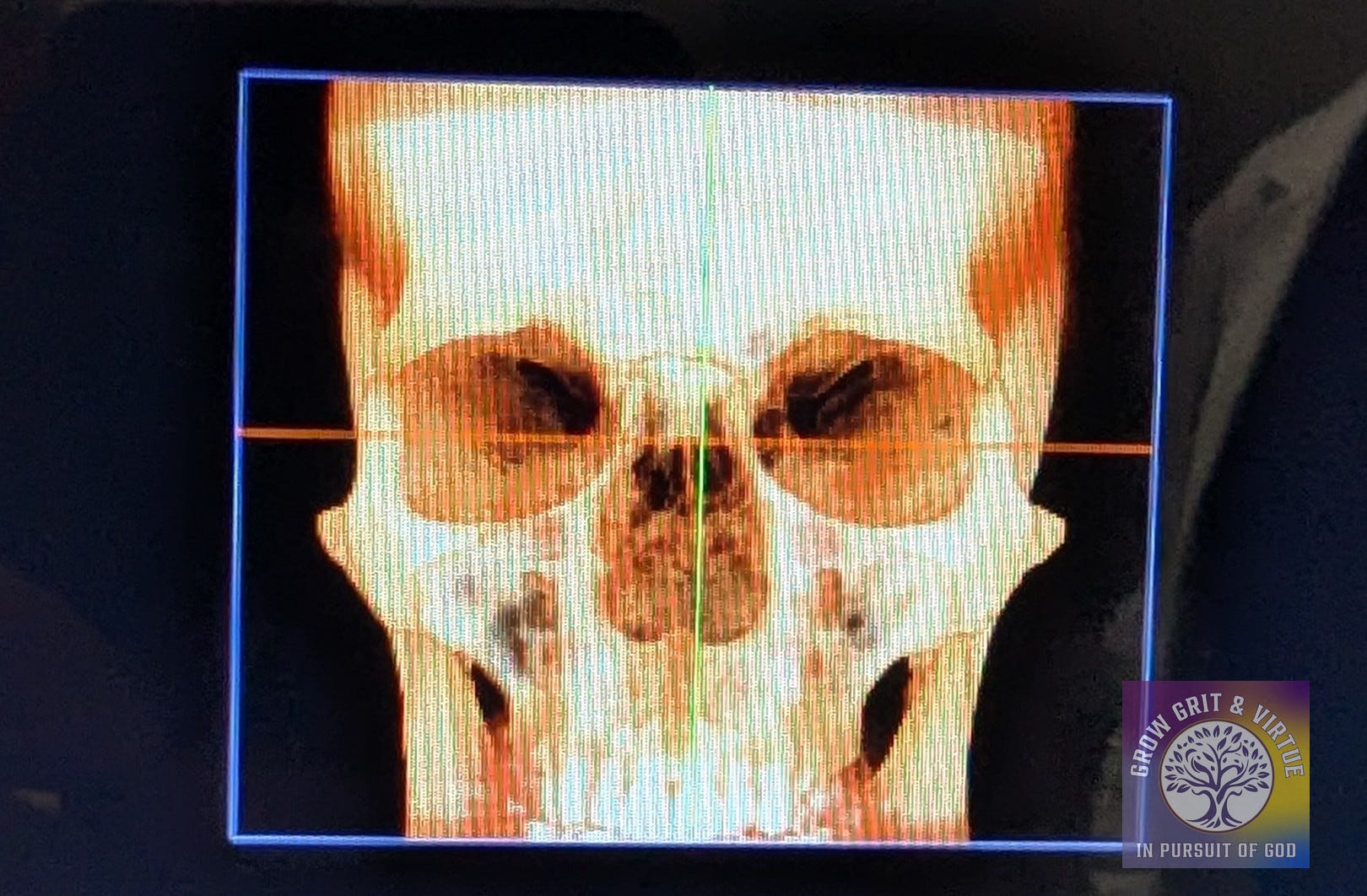
The surgeon turned his monitor toward me so I could see why I don’t breathe well at night, and for a minute I stopped hearing what he said. On the screen, glowing gray and white, was my skull.
I have carried that skull my whole life. I’ve taken it everywhere with me. It has been closer to me than my own wife, and until that morning I had never once laid eyes on it. The thing nearest to me in the whole world turned out to be a stranger.
The first thing I noticed was that it was grinning. Skulls always do, because there is nothing left to cover the teeth. My second thought was that it was pretty cool. I have seen plenty of skulls in movies and on Halloween decorations, but I had never seen the one I’ve been walking around in, and I couldn’t stop looking at it.
There’s an old Latin name for what I was doing. Memento mori. It’s Latin for “remember that you will die.” For centuries Christians kept that reminder close. The old paintings of St. Jerome show him at his desk translating the Bible with a skull sitting next to his books. Under a Capuchin church in Rome there are chapels decorated with the bones of thousands of friars, and a sign there tells the tourists, “What you are now, we once were. What we are now, you will be.”
That sounds morbid to most of us. We hide death and dress it up at funeral homes so it looks like a nap, but a man who remembers he will die stops spending so much energy pretending he won’t.
I was in that office at all because I have never been able to breathe through my nose. As far back as I can remember, I’ve breathed through my mouth. More than twenty years ago a doctor told me I had severe sleep apnea, and I went through one CPAP machine after another trying to make them work. None of them did. Every time I put on the mask I felt claustrophobic, like I was suffocating. Eventually I gave up and went back to no treatment at all, and stayed there for twenty years. My wife has spent those years nudging me awake, keeping me alive, or escaping into another room so she could actually sleep.
Only recently did I learn why the machines never worked. They were pushing air into passages that weren’t open to receive it. Meanwhile, all those years of too little oxygen have started to take a toll on my body. I can feel it in my balance and see it in the way I walk. My brain has been crying out for air for a long time. If the surgeon can open those passages and let the oxygen through, a lot of what has been going wrong may finally start to ease.
The surgery itself is on my nose. The doctor will go in with tiny cameras and straighten what has been crooked for years so air can go where it’s supposed to go. To help me breathe, he has to break a little bone. In Genesis, the nose is where the human story begins. “The LORD God formed the man out of the dust of the ground and blew into his nostrils the breath of life, and the man became a living being” (Genesis 2:7). A chapter later, after the man has made a mess of things, God tells him how it will end. “You are dust, and to dust you shall return” (Genesis 3:19). Those are the words the priest says when he smudges ashes on your forehead every Ash Wednesday.
So on that screen I was looking at the dust part, the frame God shaped out of the ground before He breathed into it.
Jamie wanted to know if the surgery would change my voice. The doctor said nobody else would hear a difference. Some patients notice a small change in how they sound to themselves, though, because we hear our own voices partly through the bones of our own heads. Everyone else hears my voice through the air, the way it really sounds. I hear it through my skull. That’s why nobody likes hearing a recording of himself. The recording is the voice everybody else has been hearing all along.
I keep turning that over. I am the last person to know how I sound. My wife knows. So do my kids. They have heard the truth of my voice for years, while I’ve only heard it filtered through bone. Humility starts with accepting that the people around you may see you more clearly than you see yourself. The psalmist asks God for exactly that kind of hard news. “LORD, let me know my end, the number of my days, that I may learn how frail I am” (Psalm 39:5).
The Church spends the end of every year thinking about death. In November we pray for the dead, and the Sunday readings near the end of the church year are about the end of the world. Meanwhile the stores have been playing Christmas music since Halloween. Advent opens with the promise that Christ will come again to judge the living and the dead, and only after that does it walk us toward the manger. This year I’m seeing endings and beginnings side by side in my own life. Soon a surgeon will open my airways so I can take in the oxygen I’ve been missing most of my life. My father is in the last stretch of his life. My son is getting ready to marry. His wedding is a new beginning for him, and it is also an ending for us, because the years of raising him under our roof are closing. Something in our family will die that day so that something new can be born.
Psalm 90 prays, “Teach us to count our days aright, that we may gain wisdom of heart” (Psalm 90:12). You only count what runs out. When my family sits down at Thanksgiving next week, I want to remember that our seats at that table are numbered too. A meal is better when you know it ends. You eat slower, and you listen to the long story you’ve heard a dozen times before.
My father is in his nineties. His own father was born around 1863, during the Civil War, so between the two of them they have seen most of this country’s history. Dad is still with us, and I know the day is coming when I’ll stand at his grave, a grown man with children of my own, and feel like an orphan. There will be nobody left ahead of me in line and nobody to call when I don’t know what to do.
I’m standing between a father heading toward the grave and a son heading toward the altar, and I worry about both of them. I worry about the rest of my kids too, and about prices and wars and a world that seems less sure of itself every year. When I worry like that, I’m assuming I’m the one holding everything up.
That skull has held me up my whole life without any help from me. God made it out of dust before I had my first worry, and He can hold my children up the same way, in ways I’ll never see. On the night before He died, Jesus told His friends, “I will not leave you orphans; I will come to you” (John 14:18). Advent is the season of that promise.
St. Paul wrote that “we hold this treasure in earthen vessels, that the surpassing power may be of God and not from us” (2 Corinthians 4:7). An earthen vessel is a clay jar. On the screen I saw my jar, a little crooked inside. In a couple of weeks they’ll put me under for the first time in my life, and a stranger with a camera will do some careful work inside it. I’ll wake up sore and spend the next month rinsing my nose the way the instruction sheet says. One day, Lord willing many years from now, the jar will go back to the ground it came from.
The Church’s night prayer, which priests and plenty of ordinary people say before bed, ends with a line I used to think was gloomy. “May the all-powerful Lord grant us a restful night and a peaceful death.” Now it sounds like the most sensible thing a man can ask for before he closes his eyes.
So here’s my skull. When I showed it to my thirteen-year-old daughter, she said, “It even looks like you.” She’s right. It is the most honest picture anyone has ever taken of me. There’s no good side and no expression to manage. I plan to look at it now and then this Advent, the way St. Jerome looked at his, and remember that I am dust God chose to breathe into.
Thank you for reading. This one meant showing you a picture most people never see.
If these essays have been worth your time, I’d be glad to have you subscribe. A free subscription brings each new essay to your inbox. A paid subscription does that and something more. It helps support Shield Bearer Counseling Centers, the Christian nonprofit I lead here in the Houston area, where we help people get licensed counseling and work hard never to turn anyone away.
Giving Tuesday is December 1, the Tuesday after Thanksgiving. If you’re deciding where your end-of-year giving will go, I hope you’ll consider Shield Bearer. A gift helps someone sit down with a counselor they couldn’t otherwise afford.
Thanksgiving is next week, and Christmas and the new year aren’t far behind. However many seats are at your table, I hope you’ll eat slow and listen to the long stories. I’ll be praying for you, and I’d be grateful if you’d pray for me as I head into surgery.
Loved this…also commiserating with your wife.
Such an important observation.
Praying for surgical success, and for better sleep for you! 🙏🏻🙏🏻🙏🏻