


There’s a moment that sneaks up on most of us that’s quiet, subtle, and dangerous. Whether you're a parent, a spouse, or someone simply trying to live faithfully and navigate life’s demands it takes hold. More often than not, it doesn’t show itself in loud significant moments like screaming matches or financial crises, though it’s certainly revealed here. Rather, it's first revealed long before in the quiet moments—usually when you're standing at the sink, staring into the distance, wondering why you're so exhausted and so behind at the same time.
It’s the moment when a voice—often your own—says:
“What’s the point?”
That’s when it starts. Not with a breakdown, but with something more dangerous: a slow erosion of the soul. A kind of spiritual dehydration. Despair doesn’t show up in black—it shows up in muted beige. And that’s the real crisis. Not the mess. Not the conflict. The real danger is when despair slips in and becomes normal, tired, justifiable, and quiet.
Despair doesn’t always scream. Sometimes it just folds laundry and forgets to pray. Sometimes it makes a spreadsheet instead of a confession. Sometimes it smiles politely while inwardly doubting anything will ever change.
And if despair is the silent suffocation of the soul, presumption is its overconfident twin. It’s not the cry of “God, I’m too broken,” but the shrug of “God’s fine with me as I am. I don’t need to change.” It’s the comfort that calcifies. The belief that because God is merciful, we don’t have to live like He’s holy. That because He’s forgiving, we don’t have to be obedient. That because He understands, we don’t need to repent.
Despair keeps us from asking. Presumption keeps us from striving.
Both keep us stuck.
The Desert Antelope That Doesn’t Give Up
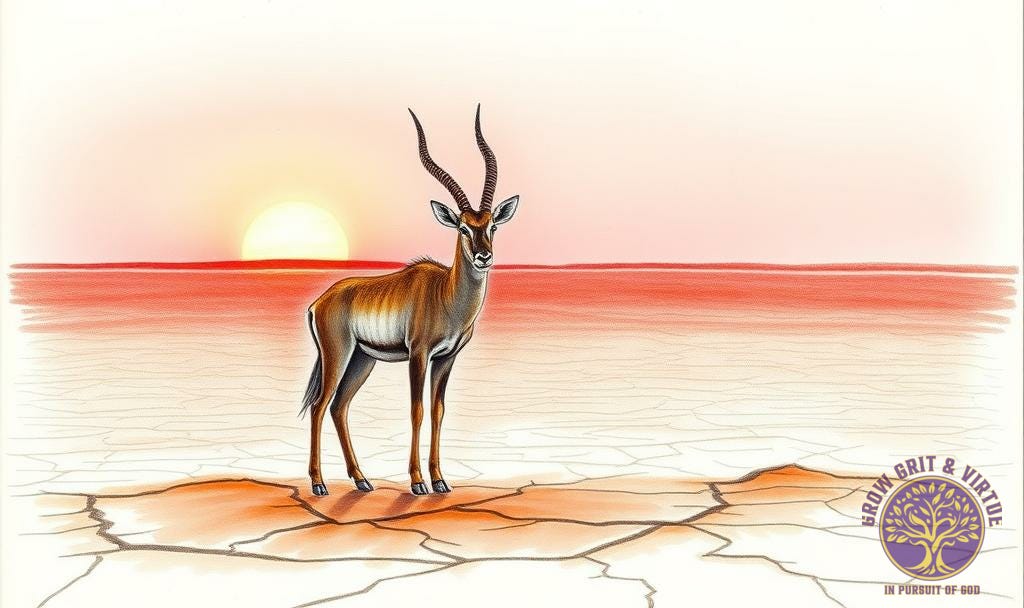
There’s a creature that lives in the places where nothing should live. The Gemsbok (or Oryx gazella) roams the blistering deserts of southern Africa—especially the Namib and Kalahari—where shade is rare and water even rarer. The Namib and Kalahari deserts are more moonscape than landscape. Temperatures soar past 113°F. Rain disappears for months, even years. The air shimmers with heat.
