

Give Us This Day Our Daily Sourdough

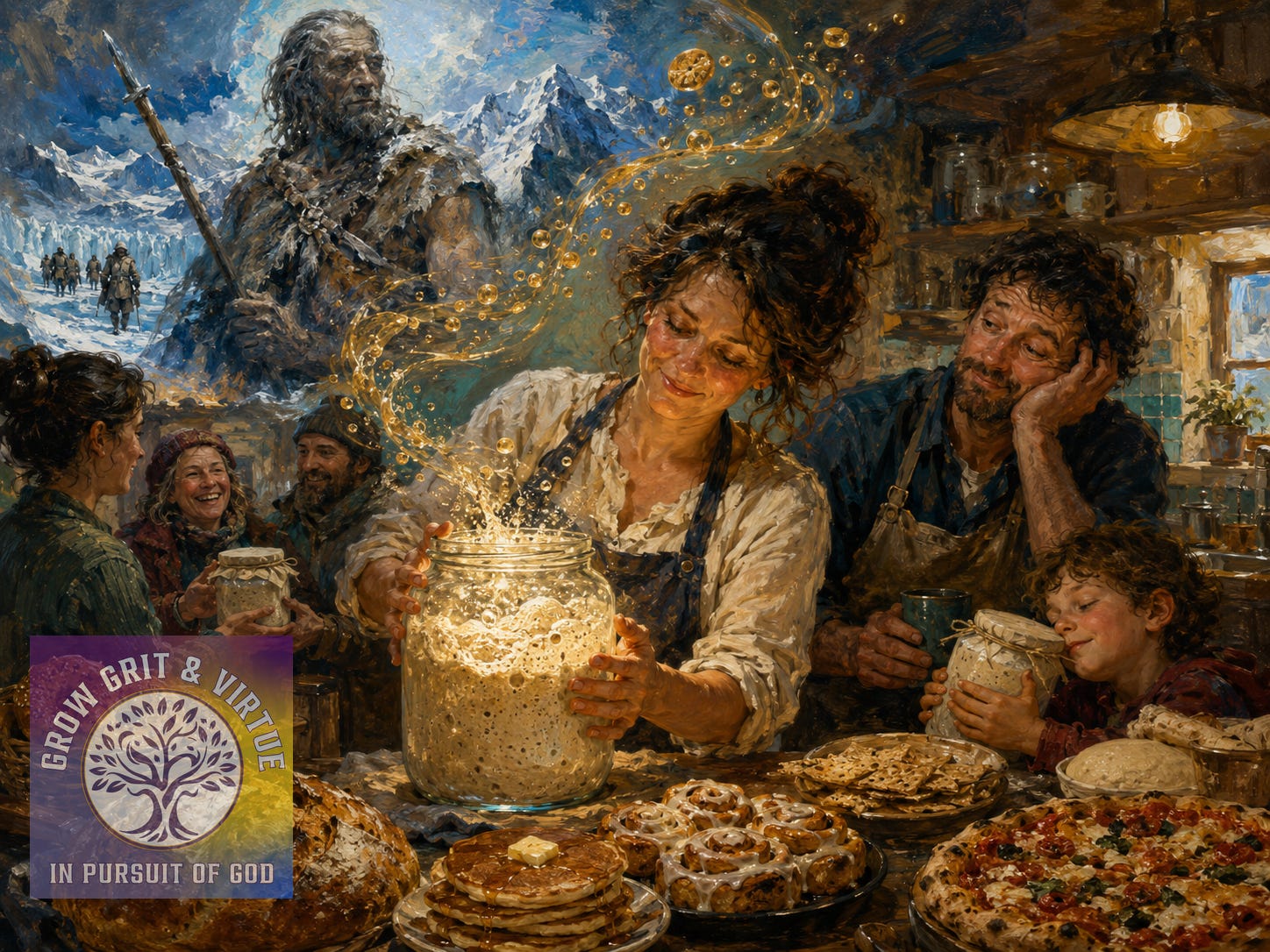
Apparently, scientists recently found yeast in and around Ötzi the Iceman, a 5,300-year-old mummy, and used it to make sourdough bread. This is the kind of news story that makes me look at my wife’s sourdough starter differently. I used to think it was just flour and water in a jar. Now I’m wondering if it is an ancient life form, a kitchen pet, or possibly a future archeological discovery.
My wife has entered the sourdough phase of life. For those who have not experienced this, sourdough is not simply “making bread.” It is more like adopting a tiny bubbling creature that lives on your counter, needs regular feeding, reacts to the weather, has moods, and somehow becomes the emotional center of the household.
It must be fed. It must be watched. It must not be neglected. It rises. It falls. It smells mysterious. It has good days and bad days. In other words, it is basically another child, except this one occasionally turns into pancakes.
And like any proud parent, my wife is now handing out pieces of the starter to anyone within range. Friends, neighbors, relatives, delivery drivers — no one is safe. It is not so much “Would you like some starter?” as it is “Congratulations, you are now responsible for keeping this alive.”
The science, though, is genuinely fascinating. A sourdough starter is a living culture of wild yeast and lactic acid bacteria. The yeast helps dough rise, while the bacteria produce acids that give sourdough its tangy flavor and affect the texture, shelf life, and digestibility of the bread. Sourdough traditionally develops through wild yeast from the environment and fermentation over time, which is why it differs from standard yeasted bread.
This is also why sourdough feels so old-fashioned and so futuristic at the same time. It is ancient food technology. Before commercial yeast packets, before bread machines, before “gut health” became a marketing slogan, people were using fermentation to make grains more flavorful, more useful, and easier to work with. Now scientists are baking with yeast from a mummy, which proves that sourdough has officially crossed from “homestead hobby” into “Indiana Jones meets The Great British Bake Off.” Researchers baked bread using cold-adapted yeast found on Ötzi’s body and described him not as a static relic, but as a dynamic biological system.
Health-wise, sourdough may be easier for some people to digest than ordinary white bread, and fermentation can influence starch digestion, FODMAPs, protein digestibility, and mineral availability. The fermentation process may also reduce some gluten.
The trend makes sense, though. People are tired of ultra-processed food and are drawn to things that feel slower, simpler, handmade, and connected to tradition. Sourdough has all the right modern buzzwords: fermented, artisan, gut-friendly, clean-label, ancestral, rustic, authentic. It is basically the farmhouse table of carbohydrates.
Of course, the trend has also gone a little wild. We are no longer content with sourdough bread. Now there are sourdough crackers, sourdough bagels, sourdough pizza crust, sourdough cinnamon rolls, sourdough pancakes, sourdough discard recipes, sourdough everything. At this rate, someone will soon release sourdough toothpaste and claim it supports oral microbiome resilience with notes of toasted wheat and mild regret.
Still, I have to admit there is something beautiful about it. In a rushed world, sourdough refuses to be rushed. It demands patience. It rewards attention. It teaches that good things often grow slowly, quietly, and with regular care. It reminds us that our homes are not sterile machines; they are living places full of invisible activity, shared meals, and small acts of stewardship.
So yes, my wife’s starter may be another child. It may need feeding. It may take up counter space. It may multiply and be distributed like edible chain mail. But it also gives us warm bread, a good laugh, and a reminder that life is always fermenting around us.
And frankly, if scientists can make bread from a 5,300-year-old mummy, then I suppose I can keep feeding the jar on the counter.
But I am not paying for its college.
Thank you for reading and sharing a laugh with me. Your support here helps sustain the work of Shield Bearer Counseling Centers, where we help individuals, couples, and families find hope and healing, and it also supports my work at Grow
Grit and Virtue, where I write and teach about faith, character, resilience, and the good life.
I’m grateful you’re here. Thank you for subscribing, sharing, and giving as you’re able.